Getting Embedded Linux Devices Ready for the Cyber Resilience Act
The Cyber Resilience Act makes the ability to ship security updates for years a property of your product. We assess where your device stands and build the technical foundation: a signed, fail-safe update path, a secured boot chain and an SBOM from the build.
Fixed-price entry point:
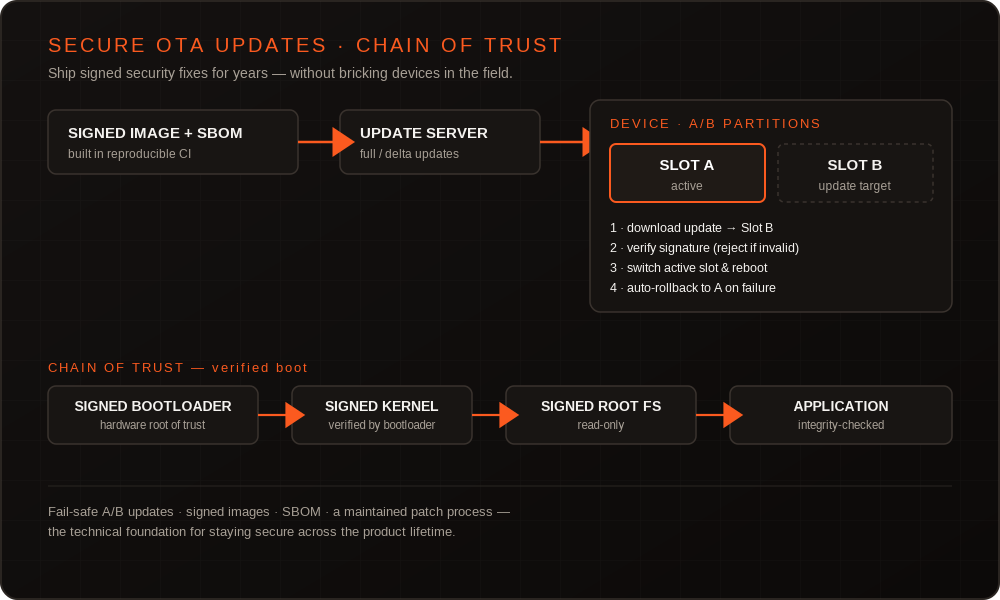
What does the CRA demand technically of an embedded Linux device?
Above all one thing: that you can ship signed, verifiable security updates over a defined support period – without bricking a device in the field.
The Cyber Resilience Act covers products with digital elements, which means almost every connected industrial and embedded device. It does not prescribe a technology but essential requirements. On an embedded Linux stack, most of them have a direct technical counterpart:
| CRA requirement | Technical measure on embedded Linux |
|---|---|
| Security updates over the support period | Fail-safe A/B updates with automatic rollback, signed update bundles |
| Integrity and protection against tampering | Secure boot chain of trust, signed images, read-only root filesystem |
| Software bill of materials (SBOM) | SBOM from the build, for instance in SPDX format from Yocto |
| Handling vulnerabilities | CVE checks in the build, backports on LTS branches, reproducible rebuilds |
| Secure by default | A minimal image without unused services, hardened defaults |
| Traceable versions | Reproducible, pinned builds and versioned release artefacts |
None of this is exotic; in long-lived embedded Linux each of these measures is established practice. The CRA makes them mandatory and ties them to a support period measured in years. The mapping is not exhaustive, and meeting these measures does not by itself establish conformity.
What does CRA readiness at bitshift cover?
An assessment of your device, then the technology that is missing.
- Gap analysis of the update chain – partition layout, boot chain, signatures and key management, rollback, plus the SBOM and vulnerability handling in the build
- Fail-safe updates – A/B partitioning with signed images and automatic rollback, with RAUC, SWUpdate or the bsdk Simple Updater
- A secured boot chain – secure boot from the bootloader through kernel and device tree to the root filesystem
- SBOM and CVE checks from the build – machine-readable and generated automatically rather than maintained by hand
- Reproducible releases – a CI that produces the signed update, the SBOM and a CVE report as versioned artefacts for every release
- Keys out of reach – signing keys in a hardware security module or a managed key service rather than in the source tree
Why can this not be retrofitted shortly before the deadline?
Because the decisions that determine whether a device can be updated are made at the very start of a platform’s life.
Partition layout, boot chain and key management are fixed when the BSP is created. A device shipped with a single image and no root of trust does not gain either through a configuration change. That is why the deadlines leave less room than they seem to: anyone bringing devices to market in 2027 whose platform is being built today is deciding now. The gap analysis shows where your device stands and which measures, in which order, make the biggest difference.
How does a device stay secure for years?
Through a loop that runs the same way after every new vulnerability: detect, fix, rebuild, roll out.
You cannot patch what you cannot see. The SBOM from the build describes every package actually in the image; Yocto’s cve-check compares that state against public CVE data on every build. If a vulnerability affects the device, the fix is backported on a maintained LTS branch, the image rebuilt reproducibly and shipped through the signed update path. So that a security update does not bring a new problem with it, it can be checked on real hardware before rollout – with our Embedded Testrack. How we build the layers and the distribution for this is described under Yocto BSP & Distributions.
Which update solution fits your device?
That depends less on the framework than on how your devices can be reached and how you manage the fleet.
Connected devices receive their updates from an update server, as a delta update that transfers only the changed blocks if you wish. Devices without a connection are updated on site, for instance from a USB stick – for that we built the bsdk Simple Updater with a user interface right on the device. The same pattern applies in both cases: the update lands in the inactive slot, the device verifies the signature before touching it at all, and on reboot it falls back to the known good state automatically if the new one is not confirmed. An interrupted update costs a reboot, not a service call.
Where does our work end?
At the technology. The legal assessment and the organisational obligations remain with the manufacturer and its legal counsel.
We deliver the technical foundation and the evidence that comes out of the build – SBOM, CVE reports, signed and versioned releases. Processes such as coordinated handling of reported vulnerabilities, reporting actively exploited ones and the conformity assessment belong in your organisation; we set up the technology behind them so that it carries those processes. The fixed-price package “Update readiness & CRA preparation” is a good entry point; larger or different undertakings we quote individually. We work remote-first, wherever your team is based, on site when needed, in German and in English. The technical background is covered in detail in the article The Cyber Resilience Act and Secure OTA Updates.
From our work
A selection of matching projects. Client work is usually confidential, so we show it anonymized – we're happy to share details in a personal conversation.
- 20
- years of experience
- 100+
- projects delivered
- Industries
- Medical Technology · Industry 4.0 · Automotive · Life Science · Retail · Energy · Agricultural Machinery · Food Technology
- By industry →
Industrial Automation
Edge Gateway for Plant Control
Yocto-based Linux distribution for an industrial edge gateway with OTA updates, secure boot and a C++ middleware connecting fieldbuses to the cloud.
- Yocto
- C++20
- OPC UA
- MQTT
- Secure Boot
Retail Technology
Self-Service Kiosk System
Robust Embedded Linux kiosk system with a custom Qt interface, kiosk-grade lockdown and a maintenance-friendly remote management and update solution for hundreds of devices.
- Embedded Linux
- Qt
- Fleet Management
- OTA
Update readiness & CRA preparation
How well is your device prepared for what the Cyber Resilience Act will demand of updates and vulnerability handling?
Not every undertaking starts with a project. If you first need a solid basis, this package is the shortest way there – with a fixed price and a fixed result.
What it includes
- Review of the update chain: partition layout, boot chain, signatures and key management, rollback
- SBOM and vulnerability handling in the build
- Closing session with your team
What you get
- A gap analysis with prioritised technical measures and a rough effort
One device or a product line sharing one software base.
Not included
- Legal advice and any statement on conformity – that needs qualified legal counsel
- Implementing the measures
Frequently asked questions
- When does the Cyber Resilience Act apply?
- It entered into force in December 2024 and applies in stages. The reporting obligations for actively exploited vulnerabilities and severe security incidents have applied since 11 September 2026, including for products already on the market. The remaining obligations – among them the essential cybersecurity requirements and vulnerability handling – apply from 11 December 2027. Please clarify which obligations and deadlines apply to your product with qualified legal counsel; this is not legal advice.
- Does a Yocto- and OTA-based setup make our product CRA-compliant?
- No single technical setup establishes conformity by itself. This architecture provides the technical foundation the CRA presupposes – an SBOM generated from the build, CVE monitoring, secure boot and a signed, fail-safe update path. The organisational obligations and the legal assessment come on top.
- Which update framework do you use?
- We have used RAUC and SWUpdate in production, and for devices updated on site from a USB stick our own bsdk Simple Updater with a user interface on the device. Mender is another established option. Which one fits depends mainly on how your devices can be reached and how you manage the fleet.
- Do you also give legal advice?
- No. We assess and build the technology: update chain, boot chain, signatures and key management, the SBOM and vulnerability handling in the build. A statement on conformity and the legal assessment of your product need qualified legal counsel – we are happy to work alongside them.
Articles on this topic
How we work and what matters in practice – from our blog.
The Cyber Resilience Act and Secure OTA Updates for Embedded Linux
How the EU Cyber Resilience Act raises the bar for connected embedded Linux devices — and why secure, signed OTA updates are the backbone of compliance.
- Security
- OTA
- Cyber Resilience Act
Advantages of Yocto in Industrial Environments
Why the Yocto Project pays off for long-lived industrial products – from reproducible builds and license compliance to safe update strategies.
- Yocto
- Embedded Linux
- Industry
Yocto BSP: How to Build a Board Support Package That Lasts
How a Yocto BSP layer is structured – machine configuration, kernel and device tree, U-Boot, image layout – and the rules that keep it maintainable from one Yocto LTS release to the next.
- Yocto
- BSP
- Embedded Linux
Related services
Embedded Linux
From board bring-up to application: reliable Embedded Linux systems focused on stability, boot time and long-term maintainability.
Learn more →Yocto BSP & Distributions
Tailored Linux distributions with the Yocto Project – reproducible builds, custom layers and a maintainable update path for your product.
Learn more →Embedded Testrack
Real CI/CD with real hardware: we integrate your embedded systems into an automated test rack and validate every release through the actual input and output interfaces – 24/7, without simulated mockups.
Learn more →Technical Consulting
Architecture reviews, technology decisions and code audits. We bring 20 years of experience to your team – as a sparring partner at eye level.
Learn more →Let's talk about your project
Whether it's a new product, modernizing an existing application, or a bottleneck in your team – we look forward to hearing from you.
Start a project